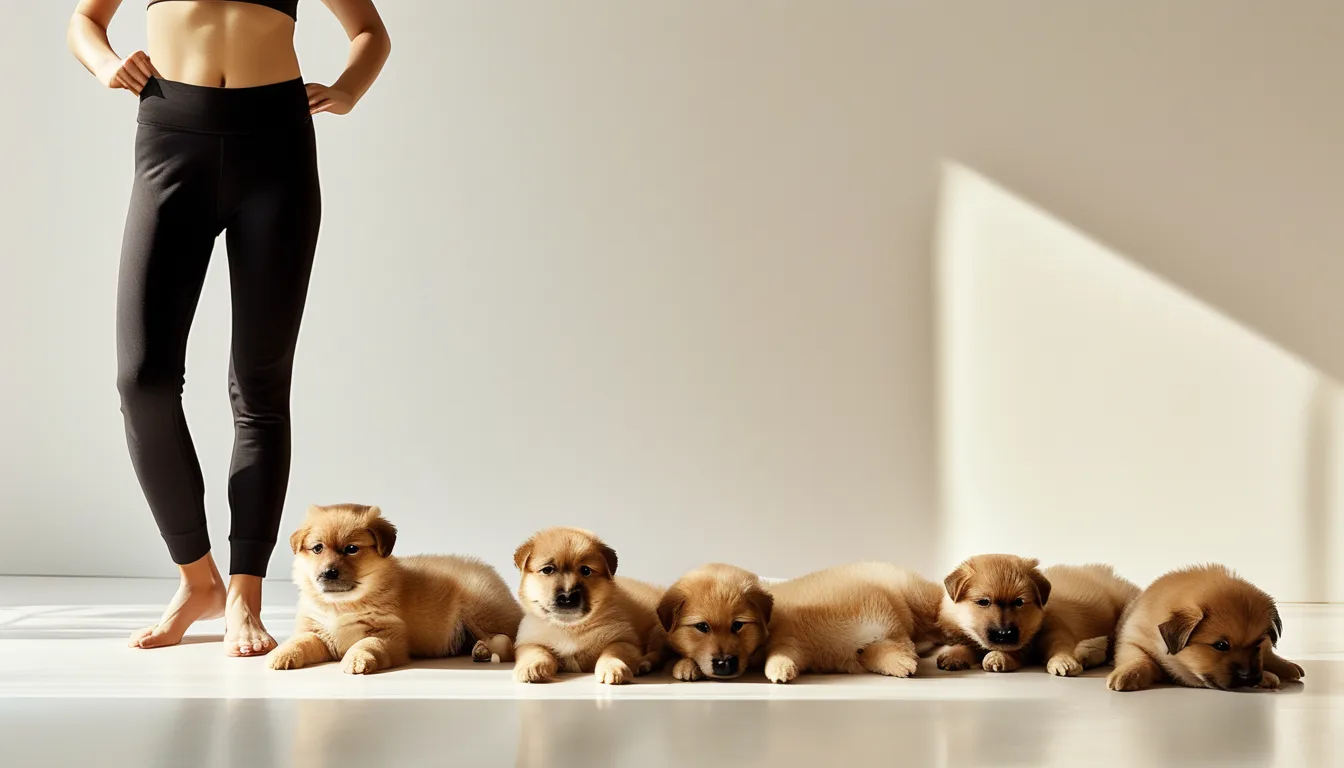
What to Wear for Daily Puppy Weigh-Ins and Health Checks
Quick Answer: The daily weigh-in outfit needs to handle kneeling for 20 minutes, hot washing every day, no loose fibres near newborn faces, and a hand free at all times. That points to smooth cotton or cotton-blend knits, mid-weight leggings with genuine knee tolerance, fitted sleeves, and an apron with a chest pocket for the pen.
What you do not want: anything looped, anything shedding, anything requiring two hands to adjust, and anything you would mind ruining.
Here is the reasoning, and the kit that lasts a full litter.

Why the daily routine is harder on clothes than it looks
The individual actions are small. It is the repetition that breaks things.
You are kneeling constantly. A whelping box is on the floor, and weighing means twenty minutes down there, twice a day, for eight weeks. That is over 200 kneeling sessions. Fabric at the knee takes more abrasion in a litter than in a year of ordinary wear, and thin leggings go through at the knee first.
Everything needs hot washing. Daily, at a temperature that actually matters for hygiene. Most nice loungewear will not survive 56 hot washes, which is roughly what a litter costs you.
Loose fibres are a genuine problem. Newborn puppies have their faces against whatever you are wearing, and fleece, brushed cotton, and knitted wool all shed. This is the reason to be picky about surface rather than a matter of preference.
You need a free hand permanently. Puppy in one hand, scale or notebook in the other. Anything that needs adjusting, holding out of the way, or two hands to manage is a genuine obstacle rather than an annoyance.
And the temperature is wrong for you. The whelping room is kept warm for the puppies, considerably warmer than you would choose. You will overheat in anything you would normally wear indoors in that season.
The kit that actually survives a litter
Small, repetitive, and entirely replaceable.
Bottoms - the piece that matters most. Mid-weight leggings or slim joggers with enough fabric weight to take repeated kneeling, around 240gsm or more. Thin summer leggings will not last a litter. A high wide waistband is worth seeking out, because you are bending forward constantly.
Consider knee protection. A pair of soft gardening knee pads, or a folded towel kept beside the box, extends the life of every pair of trousers you own and is considerably kinder to your knees. Most experienced breeders end up with something like this and wish they had started sooner.
Top - smooth and fitted. Cotton or cotton-modal, close-fitting, sleeves that push to the elbow and stay there. No loops, no brushed face, no drape. Short sleeve in a warm whelping room, with a smooth long-sleeve layer for the cooler parts of the house.
The apron with a chest pocket. The most useful single item in the routine - the pocket holds the pen, the apron takes the mess, and it swaps in five seconds without changing your clothes. A cotton apron washes hot indefinitely and costs very little.
Colour. Mid-tone solids so you can spot anything on a puppy that needs attention while not showing every mark yourself. Avoid white, which shows everything, and avoid very dark, which hides things you need to see.
And nothing on your hands or wrists. Rings, watches, and bracelets all come off before the first check and stay off for the duration.

5 Mistakes People Make With Litter-Care Clothes
1. Wearing good loungewear. It will be ruined, and the hot washing will do most of the damage rather than the puppies. Buy cheap, buy repeats, and treat it as consumable equipment.
2. Thin leggings. The single most common complaint at week four is a hole at the knee. Fabric weight is the whole answer here, and the difference between a 180gsm and a 250gsm legging over eight weeks is dramatic.
3. Scented laundry products. Puppies navigate almost entirely by scent in the first weeks, and a strongly perfumed sleeve is disorienting during handling. Fragrance-free detergent, no softener - and softener also leaves a residue you do not want near neonates.
4. Long or loose sleeves. They end up in the whelping box, in the scale, and in whatever you were trying to avoid. A sleeve you have to hold up is occupying the hand you needed.
5. Not having enough sets. Three complete sets minimum. One worn, one washed, one dry. Litter care does not accommodate a laundry schedule, and the moment you are down to one set you will wear something inappropriate.
The third one is the mistake experienced breeders mention most and new breeders have never considered.
Keeping it clean and making it last
This wardrobe gets washed harder than anything else you own, so the routine matters.
The washing routine:
- Hot wash daily, 60°C where the fabric allows. This is the temperature that does the hygiene work
- Fragrance-free, dye-free detergent, and no softener at all
- Rinse protein stains in cold water first. Hot water sets them permanently - a cold rinse before the hot wash makes the difference between a garment that lasts and one that is stained by week two
- Keep litter-care laundry separate from household laundry
- Air dry knits where possible - repeated hot drying is what turns a smooth surface fuzzy, and fuzzy is exactly what you were avoiding
Hair removal that works: a damp rubber glove dragged across the fabric beats a lint roller substantially on knits. A ten-minute no-heat tumble before washing pulls loose hair into the lint trap instead of into your machine.
The full kit and what it costs. Three pairs of mid-weight leggings, four smooth cotton tees, one smooth long-sleeve layer, three cotton aprons, and a pair of knee pads. That covers an entire litter, costs less than one nice piece of loungewear, and can be retired at the end without regret.
One thing worth doing before the litter arrives: wash everything once, on the hot cycle, before you need it. Anything that is going to shrink, bobble, or fall apart will do it then rather than in week two when you have no spare capacity for solving clothing problems.
FAQ: Litter-Care Clothing Questions, Answered
Are knee pads really necessary?
Not for a single short check, and increasingly worth it as the weeks accumulate. Most people who skip them the first time buy them for the second litter, and the ones who use a folded towel instead get most of the benefit for nothing.
Can I wear the same clothes for other dogs in the house?
Better not to - changing between the whelping room and the rest of the household is a straightforward biosecurity measure, and it is the main reason to keep this as a separate dedicated set rather than borrowing from your wardrobe.
What about footwear?
Dedicated slip-ons kept at the whelping room door, never worn outside. Bare feet in a room with very small animals underfoot is how accidents happen, and outdoor shoes bring in exactly what you are trying to keep out.
How do I stop everything smelling even after washing?
Usually residue rather than inadequate washing - an occasional wash with a little white vinegar in place of softener strips it, and washing promptly rather than leaving things in a pile does most of the rest.
TL;DR:
- Kneeling twice daily for eight weeks destroys thin leggings - go mid-weight and add knee pads
- Smooth-faced knits only; fleece and brushed fabrics shed onto newborn faces
- An apron with a chest pocket takes the mess and holds the pen, and swaps in five seconds
- Fragrance-free detergent, no softener, cold rinse then hot wash, air dry knits
- Three full sets minimum, bought cheap and treated as equipment
Before the next litter, put together three identical sets and hot-wash them once. Anything that was going to fail will fail then, not in week two.
See It in Motion
Seen here: Super High Waist Embossed Yoga Leggings with Inner Pocket — shop it on bubblelime.com
Keep Reading
This article is for general informational and styling purposes only. Fit, sizing, and product availability may vary.